
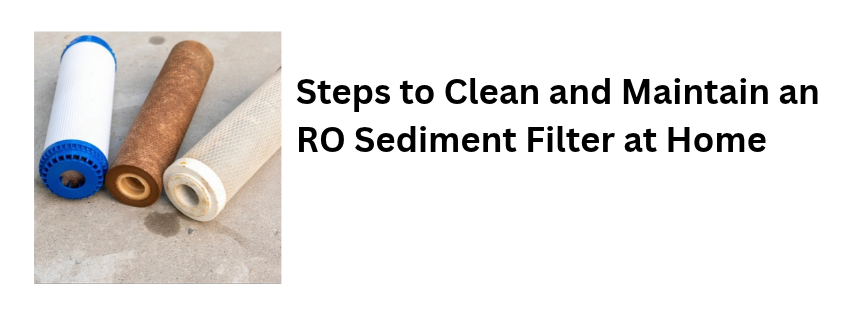
Is your RO purifier taking forever to fill a glass? Before you blame the membrane, look at the sediment filter. Sand, rust flakes, mud, fine dust: all of it gets stopped here. Once it’s choked, the flow drops and the pump strains to push water through.
What Is an RO Sediment Filter?
Think of it as the bouncer at the door. It’s a pre-filter that stops the visible and not-so-visible particles in your incoming water, so the RO membrane doesn’t clog up with dirt.
Here’s what surprises most people: in a typical home RO, the sediment filter is a throwaway cartridge. You replace it, you don’t wash it. Some purifiers do have a washable mesh screen instead, so check your manual first.
How to Maintain Your RO Sediment Filter at Home
1. Turn everything off
Switch off the power and shut the inlet valve. Let any pressure left in the line release, as your manual describes. It saves you from a wet floor.
2. Look at the housing
Check for cracks, leaks, grime, or a strange color. Some purifiers have a see-through housing, and in that case you can judge the cartridge by eye. A cartridge that has gone brown or grey is a clear sign.
If the housing is stuck, don’t force it. You can crack it, and then you’re buying a new one.
3. Rinse only what’s meant to be rinsed
If your model has a reusable screen and the manual says you can wash it, rinse it under clean running water. That’s all. Detergent and bleach can leave residue, so leave them out unless the manufacturer says they’re fine.
A cartridge is a different story. Rinsing it may make it look cleaner, but the filtering ability doesn’t come back.
4. Swap the cartridge when it’s time
Replace it if it’s clogged, damaged, or past the date in the manual. Many people end up changing it every few months, but the real answer depends on your water. If you have borewell or tanker water, or the supply turns muddy after heavy rain, you’ll be changing it more often than someone on clean municipal water.
5. Put it back and check for leaks
Fit the new cartridge with the seals sitting properly, then flush it the way the manufacturer says. Run the purifier for a bit and look over every joint for drips. A slow leak you miss today becomes a mess tomorrow.
Why This Small Filter Matters
A fresh sediment filter keeps water flowing steadily and keeps grit away from the RO membrane, which costs far more to replace.
If the flow is still weak after a new cartridge, or the water starts smelling or tasting odd, don’t wait. Get a technician to look at it. And remember that clear water can still carry things you can’t see.
Frequently Asked Questions
Can I wash and reuse an RO sediment filter?
Mostly no. Cartridges are meant to be thrown out and replaced.
How often should I change it?
It varies. Water quality and daily usage matter most. Your manual gives a baseline, and a technician who knows your local water can tell you if it needs to be more frequent.
What happens if I never replace it?
The flow slows down and dirt starts reaching the later stages. Eventually that hurts the membrane too.
Can I clean it with tap water?
Only if the maker says that specific filter is reusable. Otherwise, replace it.
Is a sediment filter enough to make water safe?
No. It catches particles like sand and rust. Dissolved salts, germs, and chemicals are handled by the other stages.
When should I call a technician?
When the flow stays low, you see leaks, the housing is damaged, or the water seems off even after you’ve done the maintenance.