
Drinking water scarcity and selecting the right source is a common concern for many Indian households. Some families depend on municipal water, while others depends or rely on water tankers, especially during water shortages. A question that often comes up is: Which one is safer for drinking?
Lets study in detail below.
Understanding Municipal Water
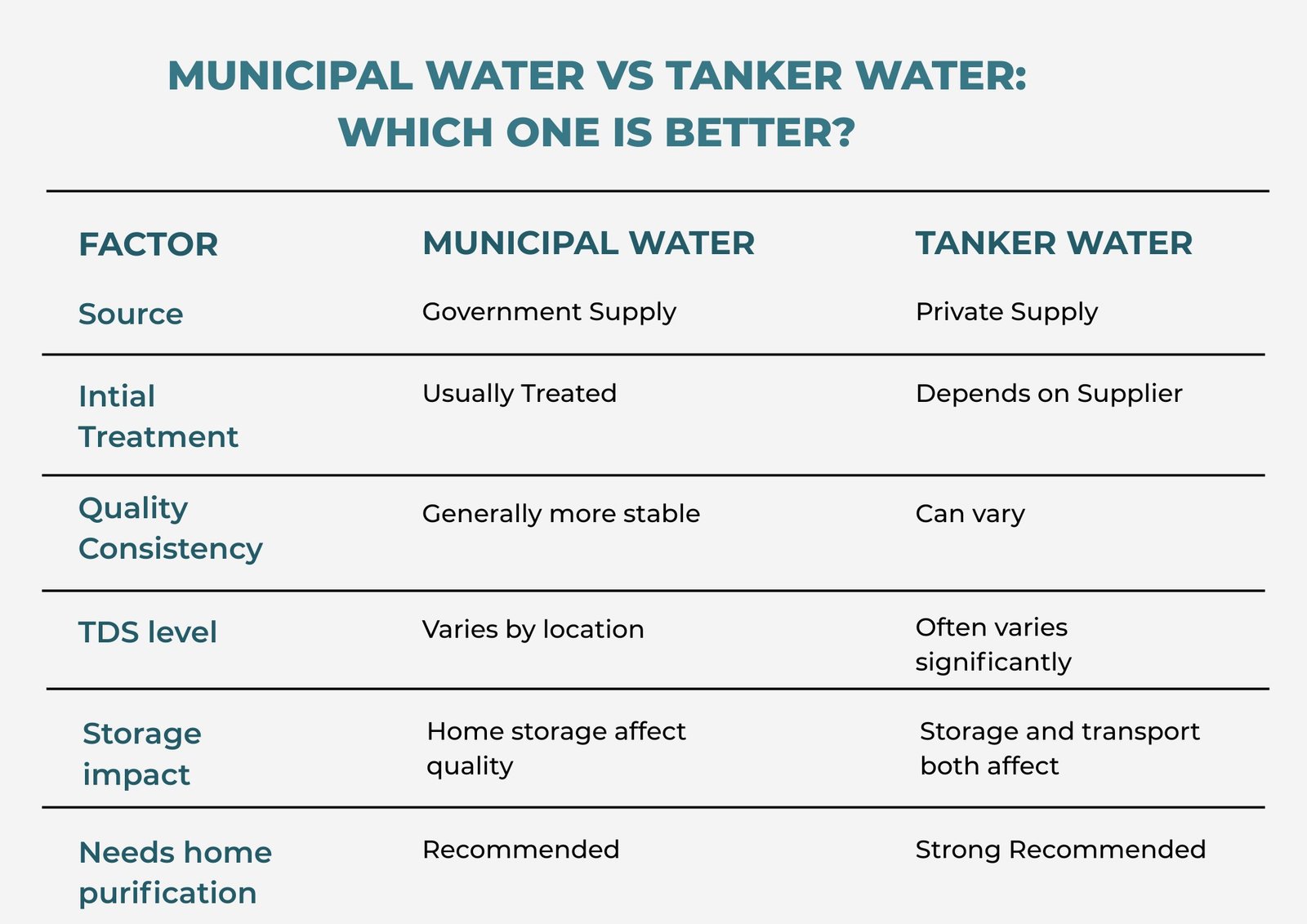
Municipal water is brought to residents by local government authorities, after it gets treated at water treatment plants. Before it’s sent out, the water is usually put through filtration, and it’s disinfected too, so that the dangerous microorganisms are reduced.
Benefits of Municipal Water
- Regularly monitored by local authorities.
- Usually treated before reaching residential areas.
- Easily available in most urban locations.
- Lower cost compared to private water supplies.
Things to Consider
Although municipal water is treated, its quality can sometimes change before reaching your home. Old pipelines, leaking distribution networks, storage tanks, and local infrastructure can affect water quality.
Water may also contain:
- Sediments
- Chlorine residue
- Rust particles
- Dissolved salts
- Increased TDS in some locations
This doesn’t automatically mean municipal water is unsafe, but it does sort of point out how important it is to check the water quality, right at the household level.
Understanding Tanker Water
Water tankers are commonly used in apartments, societies, offices, construction sites, and areas facing water shortages.
The quality of tanker water depends on several factors:
- Original water source
- Cleaning of tanker vehicles
- Transportation methods
- Storage conditions
- Frequency of water quality testing
Some tanker operators maintain high standards, while others may obtain water from different sources that vary in quality.
For this reason, tanker water quality can differ from one supplier to another.
What Should You Look for in an RO Water Purifier?
1. Choose the Right Purification Technology
Look for systems with:
- RO (Reverse Osmosis)
- UV (Ultraviolet)
- UF (Ultrafiltration)
- Activated Carbon Filter
- Sediment Filter
2. TDS Controller or Mineral Technology
Pick a water purifier that has a TDS Controller, or a Mineral Enhancer feature, so it helps in keeps the drinking water balanced while also maintain taste after the purification process, not just filtering it.
3. Water Recovery Efficiency
Modern RO systems are designed to improve water recovery and reduce water wastage compared to older models.
4. Filter Replacement and Maintenance
Before purchasing, check:
- Filter replacement schedule
- Availability of genuine spare parts
- Annual maintenance options
- Service network
5. Energy Efficiency
If your purifier uses electricity, choose a model with energy-efficient components. An efficient purifier reduces electricity consumption while operating reliably every day.
6. Build Quality
Look for:
- Strong outer body
- Leak-resistant fittings
- Quality internal components
7. Brand Reputation and Customer Support
Consider brands that provide:
- Professional installation
- Quick customer support
- Routine servicing
- Warranty coverage
8. Choose According to Your Budget
Instead, select a purifier that offers:
- Appropriate purification technology
- Reliable service
- Good build quality
- Affordable maintenance
Some families also prefer RO On Rent, which provides access to quality purification without a high upfront investment.